









The Rolex Air-King is a classic timepiece with a rich history spanning several decades. Introduced in 1945, it was initially created to honor the Royal Air Force pilots who fought in the Battle of Britain. Throughout its evolution, it has maintained a reputation for its durability and precision, establishing itself as a popular choice among pilots and watch enthusiasts.
It has experienced several updates and improvements, but its core elements have remained consistent, ensuring its continued popularity and timeless appeal. It continues to be a symbol of the brand’s commitment to quality and the enduring legacy of its aviation-inspired origins.
Interested in learning more about it? The Rolex Air King history review below delves deeper, explaining why it has remained an integral part of Rolex’s lineup and more. Let’s dive right in.
History Timeline of Rolex Air-King
Here’s a detailed breakdown of the Rolex Air-King’s amazing background:
1945 – Release of the Air-King
The Rolex Air-King has a long history and has undergone several iterations over the years. The original piece was first introduced in 1945. It was created to honor the Royal Air Force pilots who fought in the Battle of Britain during World War II.
The early Air-King watches were crafted with aviators in mind. They were designed with simplicity and a focus on precise timekeeping. Their (small) cases and clutter-free faces made time-reading easier.
The Air-King became part of the “Air Series” alongside the Air-Lion, Air-Giant, and Air-Tiger. However, of the four, it’s the only part of the series that remained in production.
Initial References: 4925 and 4499
The earliest Air-King, the ref. 4925, reflects the collection’s simple yet effective design quality. It had a durable 34mm stainless steel case- which was considered large at the time- plus a matching bracelet.
A year later, Rolex introduced the Rolex Air-King reference 4499. It was relatively similar to its predecessor, boasting all of its features and design. Both models were powered by the Caliber 10.5 (10 1/2) movement- a manual-wind hunter movement.
Manual-wind Hunter movements
Manual-wind hunter movements refer to a kind of mechanical movement that requires the user to manually wind the watch regularly to keep it running. This is done by turning the crown on the watch to wind the mainspring, which stores energy and powers the watch.
- Hunter-Case Design: A hunter-case pocket watch has a hinged metal cover that protects the watch crystal and dial. The cover typically has a small window or opening through which the time can be read without fully opening the case. This design was popular in the late 19th and early 20th centuries and added an element of protection to the watch.
- Combining the Two: Manual-wind hunter movements are the mechanical movements used in these hunter-case pocket watches. They are designed to fit within the case and are wound through the crown. The cover of the hunter case is usually adorned with decorative elements and may have a small hinge that allows the wearer to flip it open to read the time.
1953 – Transitional Ref. 6652
The vintage Air-King ref. 6652 marked a shift in the Air-King’s movement and design. It had the same stainless steel body and matching bracelet, but the real magic lay in its movement (a self-winding Caliber 1030 movement) and dial.
Introduction of the iconic creamy silver dial
It featured a creamy silver dial with stainless steel stick hour markers and sword-shaped hands- a stark contrast from the earlier Arabic numeral/ stick hour markers.
1957 – Introduction of the defining Air-King Ref. 5500

The ref. 5500 was an entry-level timepiece unique for its design and movement- marking a step further in the Air-King’s development progress.
It was among the iterations with the longest production time (32 years) and featured a 34mm Oystersteel body with a matching three-link (Oyster) bracelet. Note that it’s a non-chronometer-certified watch.
Moreover, lots of changes happened while it was in production, the main one being a change of luminous material from radium to tritium.
Oystersteel case and bracelet
It featured a 34mm Oystersteel case and a matching Oyster bracelet. The case was well-polished- typical of Rolex- and housed a similarly simple silver dial with stick hour markers and several lines of text. Interestingly, the movement option had a part to play in the text count.
Caliber 1520 or 1530 movement
The watch came with two self-winding movements- the Calibers 1520 and 1530- both of which were created in-house. The Caliber 1530 came first (1957) and had a lower frequency (18,000vph) than the Caliber 1520.
On the other hand, the Caliber 1520 was introduced in 1965 and had a more superior 19,800vph frequency.
Rolex introduced a clever way to differentiate which movement was in which ref. 5500. Refs. 5500 with the Caliber 1530 had the words ‘Super Precision’ on their dials at 6 o’clock. Meanwhile, timepieces with the Caliber 1520 had the text ‘Precision’ on their faces.
Absence of chronometer certification
The Rolex Air-King ref. 5500 was never chronometer certified in both dial options. This was because it was an entry-level watch. However, it kept time accurately and maintained its unique charm.
Notable “Double Red” variation
Aside from the ‘Precision’ and ‘Super Precision’ ref. 5500 choices, there was another special variant that emerged- the ‘Double Red’. It featured the texts ‘Super Precision’ and ‘Air-King’ in red. It’s a much sought-after collector’s item for its rarity and unique appearance.
Corporate-stamped dials (e.g., Dominos)
Rolex partnered with different organizations during the ref. 5500’s run time. The customized versions of the iteration had the businesses’ logos on their dials at 6 o’clock. Some of the businesses that enjoyed the partnerships include:
- Domino’s Pizza
- Winn Dixie (a US Supermarket chain)
- Pool Intairdril (Libyan oil company)
1958 – Introduction of the Air-King-Date Ref. 5700
Rolex introduced the Air-King Date ref. 5700 due to the ref. 5500’s popularity. It was crafted mostly for the Commonwealth markets and was in production for approximately 30 years.
Similar design aesthetic to Ref. 5500
It’s modeled heavily after the ref. 5500, evident from its 34mm stainless steel case, Oyster bracelet, and warm minimalist silver dial.
Inclusion of a date function
The major feature that set it apart was its date function at 3 o’clock. The date window was amplified by a magnifier lens on the watch’s protective acrylic dial.
Additionally, the timepiece also employed different movements- either Caliber 1525 or 1535- to support the date feature.
Brief mention of Ref. 5504
During this time, Rolex also produced a larger 35mm ref. 5504 with a steel case and bracelet. Most of them had Explorer-style dials with Arabic numerals at 3,6 and 9 o’clock, while others had the typical Air-King dial setup.
1989 – Introduction of the modern Air-King Ref. 14000
1989 saw more improvement to the Air-King’s design through the ref. 14000, although it still sported the accepted 34mm stainless steel case and Oyster bracelet.
Design changes: Arabic numerals at 3-6-9 hours

It did have some notable thrill to its design, starting with the use of Arabic numeral hour markers at 3,6 and 9 o’clock with stick markers on the other positions.
Engine-turned bezel as an alternative (Reference 14010)
Rolex introduced the ref. 14010 that same year. It had the same qualities as the ref. 14000, except for its decorative stainless steel engine-turned bezel that served as an alternative to the more popular fluted bezel.
Upgrade to Caliber 3000 movement
The 14000 also enjoyed a newer Caliber 3000 movement (at the time). Although it wasn’t COSC-rated due to production costs, it offered a 42-hour power reserve and a higher 28,800vph frequency.
Transitioned to Caliber 3130 in 2000
The new millennium heralded a change of the 14000 to 14000M. The new model had a new movement- the Caliber 3130-that had all of the Cal. 3000’s features except for a full balance bridge and Breguet overcoil.
2007 – Introduction of Air-King Ref. 114200

The Air-King ref. 114200 transformed the Air-King’s general look. It had a bolder case (still 34mm) with wider lugs and a 904L Oyster bracelet and clasp with completely solid links. Its wider array of dial options and noticeable wrist presence added to its appeal.
Replacement for the 14000 collection
The 114200 replaced the 14000 collection and is often referred to as the bling collection. This is because of its use of gold in one of its models.
Introduction of Ref. 114234 with white gold fluted bezel
The ref. 114234 was among the three models in the 2007 collection. It stood out for its white gold fluted bezel that gave the Air-King a dressier appearance. The 114200 had a smooth bezel while the 114210 had an engine-turned bezel.
Chronometer certification
It was still powered by the Caliber 3130 movement. However, this model’s movement was finally COSC-certified- a first in the Air-King history. Therefore, the ‘Precision’ text was replaced by the ‘SUPERLATIVE CHRONOMETER OFFICIALLY CERTIFIED’ print.
2016 – Discontinuation and return of the Air-King
The Air-King was discontinued in 2014 and replaced by a new Oyster Perpetual model. However, it resurfaced in 2016, looking bigger, bolder, and sportier with a touch of class.
Introduction of Ref. 116900

Revival came in the form of ref. 116900, that’s the modern Air-King. It boasts plenty of exciting new features- physically and functionally.
40mm Oystersteel case
Let’s start with its larger 40mm Oyster case (similar to the Milgauss ref. 116400’s), that’s a huge step forward from the previous 34mm size. It also boasts an inner magnetic-resistant shell and a single dial color option, i.e., black.
Inclusion of Caliber 3131 movement
The ref. 116900 houses a Caliber 3131 movement, which is anti-magnetic and automatic. It has a 48-hour power reserve and precision rating of -2/+2 seconds per day.
Unique dial design: 3-6-9 numerals, green text
The iteration also has a unique dial that borrows heavily from the Rolex dashboard instruments designed for the Bloodhound Super Sonic Car.
It features applied 3-6-9 Arabic numeral hour markers with painted Arabic minute numerals at five-minute intervals. It also has a coronet in daffodil yellow and the ‘Rolex’ text in green- a color choice mirrored in the seconds hand.
Polarizing design choice
It was a polarizing design choice by Rolex’s standards, allowing them to have fun while producing an equally effective timepiece for modern watch enthusiasts.
Rolex’s strategic approach
The ref. 116900 also allowed Rolex to bring something fresh and exciting to the table without affecting the brand’s overall luxurious reputation.
The Oyster Perpetual collection held down the simple yet sophisticated look, the Daytona, Submariner, and Explorer exuded a masculine and serious design. Meanwhile, the new Air-King presented a lovable and playful design with colorful dial aesthetics. So, win-win!
Rolex Air-King References in Summary
Ref. 4925, the first Air-King

The Rolex Air-King story begins in 1945 with the release of Reference 4925. As the first-ever Air-King, this model featured a familiar Oyster case, but its design is different from modern examples. Its approach paid homage to the British Royal Air Force pilots who favored Rolex watches during World War II.
Ref. 6552, the transitional Air-King

The Reference 6552 marked a significant turning point in the collection’s history. It introduced the signature Rolex caliber 1030 movement, which improved the accuracy and reliability of the watch. It set the stage for the brand’s future models.
Ref. 5500, the definitive and longest-running Air-King

The Reference 5500 remained in production for 32 years and was equipped with a 34mm case and either the Rolex caliber 1520 or 1530 movement. During its long run, the Reference 5500 became synonymous with the Air-King name due to its classic design and enduring appeal.
Ref. 14000, the modernized Air-King

The modernized Reference 14000 came with significant updates, including a sapphire crystal and the Rolex caliber 3000 movement. It also featured a new, smoother bezel design, replacing the engine-turned style found on previous models.
Ref. 116900, the polarizing Air-King

The Reference 116900 was a bold and polarizing Air-King model. It provided a 40mm case and the Rolex caliber 3131 movement. The dial featured both numerals and indices and included green and yellow accents, making it a unique design in the Air-King lineup. It successfully revived the Air-King collection while garnering praise and criticism for its design choices.
Notable Air-King Wearers
Ryan Gosling

Ryan Gosling, a talented actor known for his roles in movies like La La Land and The Notebook, has been spotted wearing a Rolex Air-King. This versatile timepiece complements Gosling’s debonair style and showcases his appreciation for high-quality wristwatches.
John McCain
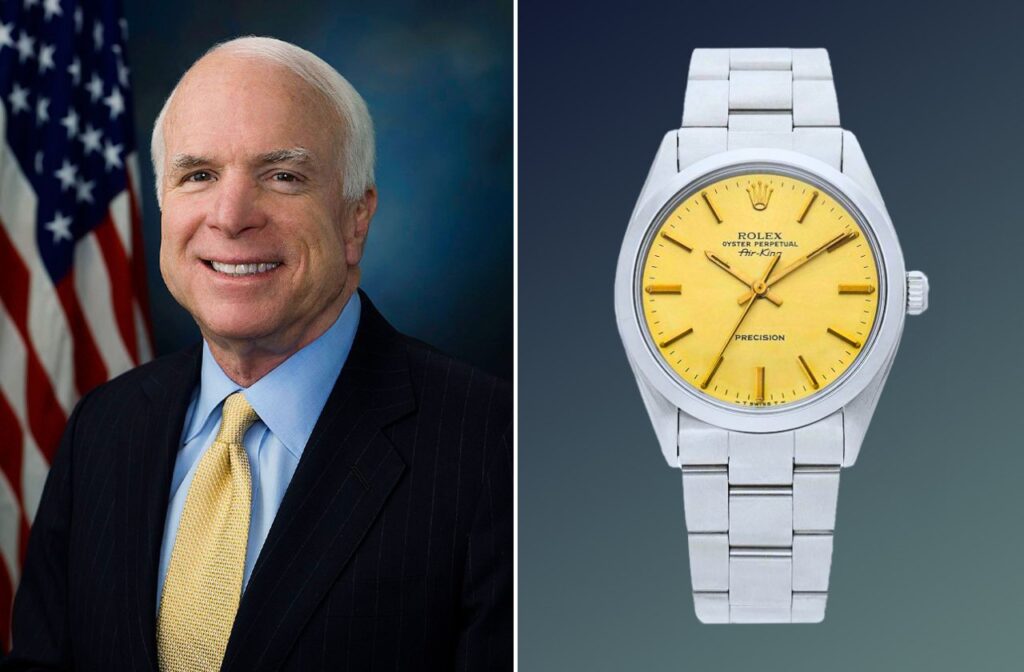
The late Senator John McCain, a respected American politician and military officer, was another notable wearer of the Rolex Air-King. McCain’s choice of the Air-King was fitting due to its roots in the aviation industry and its connection to the British Royal Air Force during World War II.
The watch’s sturdy construction and precision make it a reliable and practical choice for individuals like McCain, who held themselves to high standards.
Final Word
The Rolex Air-King’s long-standing presence in the watch industry highlights its significance and lasting appeal. With its connection to the world of aviation and various refinements over the years, it represents a culmination of dedication to quality and performance, standing as a true testament to the Rolex brand.
Key Takeaways
- The Rolex Air-King is a time-honored watch with a rich history that stretches back to 1945. Known for its versatile style and reliability, it remains one of Rolex’s longest-standing watch models in continuous production.
- Despite several changes in design, the Air-King has managed to maintain its essential character, ensuring it remains an enduring and highly sought-after watch.
- The Rolex Air-King is a good investment for its rich history, high-quality materials, availability, and value retention (or increase) with time if in mint condition.
Looking to buy or sell your luxury watches? Watch Exchange is your one-stop destination for trading Rolex, Patek Philippe, Tissot, Sinn, Zenith, and other luxury timepieces. Find your next watch today or list your item for free!